TripFlow: The App We Decided Not to Build
My role
Product research lead
Product designer
Methods
Quantitative survey, moderated user testing,
MVP build
Outcome
A data-backed, research-led decision to discontinue the product

SNAPSHOT
TripFlow — Group Travel Planning
This was a self-initiated project outside our day-to-day workload, with no roadmap mandate, budget, or stakeholder pressure attached. For this project, I partnered closely with Chris Lee (Product Manager) on product strategy and Greg Fung (Lead Engineer), but the research direction and design decisions were mine. Together, we launched our MVP. However, after deploying a 125-person quantitative survey and 6 moderated user tests, the data revealed that the core user problem lives entirely upstream of where an app can reach. Therefore, instead of spending more engineering time on a product users wouldn't adopt, we killed the project.
125
Surveys gathered
6
Moderated user tests
1
Verdict: "Don't build it"
PROBLEM
Planning a group trip is chaotic. Getting people to align on dates, destinations, and costs typically requires a dozen back-and-forths across various platforms.
Hypothesis: Users need a single, unified tool to centralize and manage the entire end-to-end planning process.
Before writing code, we pushed to validate whether a real gap existed, or whether people already had this solved.
RESEARCH
Quantitative Research: Unmasking the “Reluctant Coordinator”
The Survey: Surveyed 125 group travelers on their workarounds and pain points.
The Persona: “The Reluctant Coordinator” is the default planner who takes charge but struggles with high friction.


The Hidden Signal: Buried in our initial survey, 32% of respondents noted that their current fragmented methods actually worked fine. So while friction existed, it wasn't immediately clear if an app was the right antidote.
DESIGN + BUILD
Translating Survey Gaps into an MVP
The survey results highlighted three core pain points: group decision-making, activity coordination, and expense tracking. We used these as strict design constraints to focus our MVP scope. I knew we needed to have:
Airbnb-Inspired Architecture: I pushed for a familiar mental model early on, organizing the information architecture around distinct trip states: Exploring, Planned, Active, and Past.
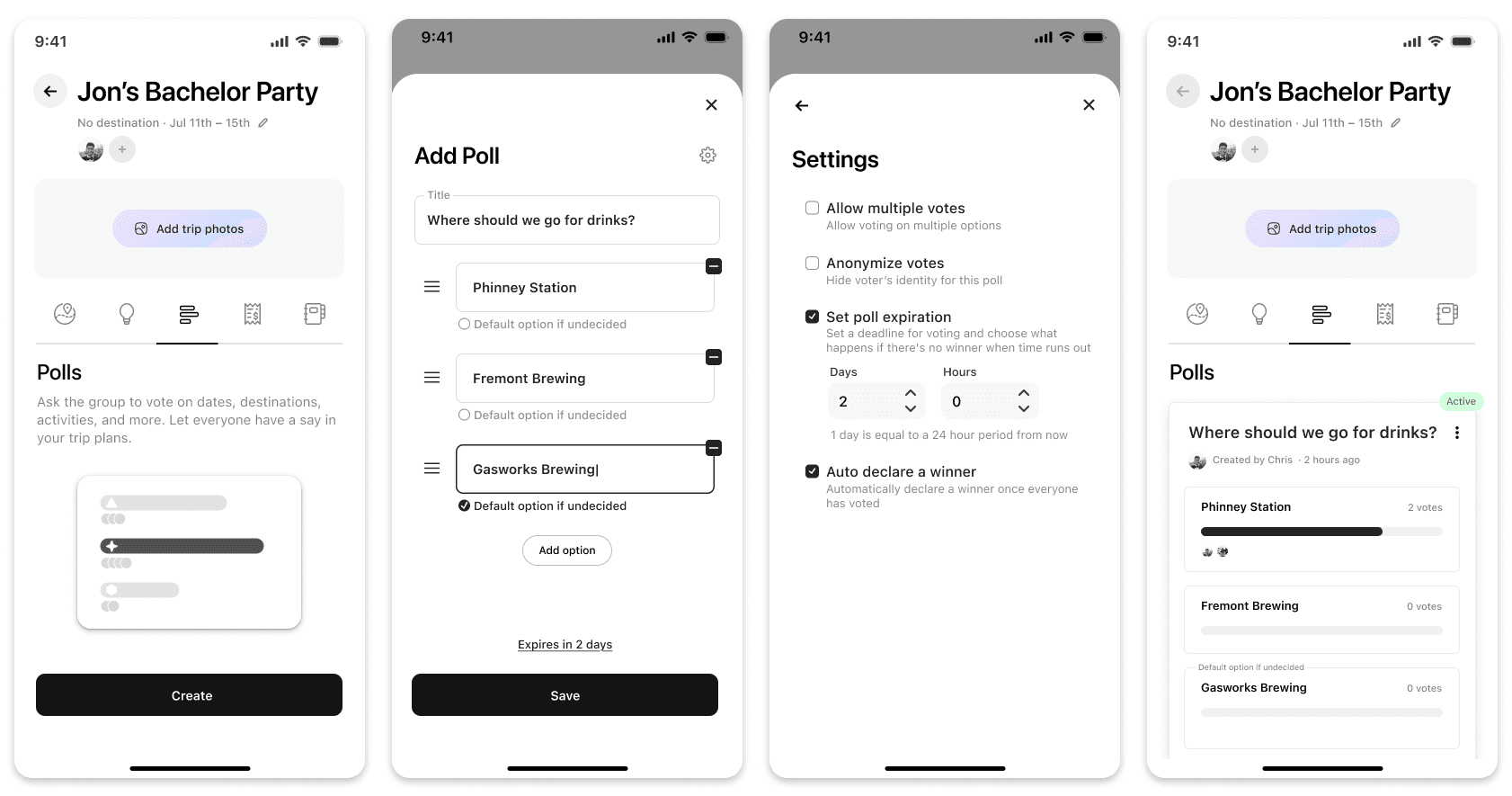
The Consensus Experiment: I designed an interactive polling system meant to nudge groups toward consensus. We didn't know it yet, but user testing would soon prove that the consensus problem lived somewhere a poll could never reach.

Each stage inherits the previous stage's tools and adds its own. Ideas and Polls stay live from Exploring through Active, reflecting how group decisions keep happening even after dates are locked.
Early concept for group decision-making
I sketched a polling feature because 125 surveyed users ranked 'making group decisions' as their absolute #1 pain point.

In collaboration with Chris (our PM), I built a high-fidelity mockup and handed it off to Greg (our developer) to start coding the MVP. The goal was a prototype real enough to produce honest behavior during testing.
Adding Polls
Hypothesis: Users would vote on locations here to reach consensus without needing to chase everyone individually.
Anonymize toggle: lets quieter members vote without pushback in the group chat
Multi-vote toggle: for indecisive groups weighing multiple options at once
Auto-expiration: so a poll doesn't outlive the window when people are actually paying attention
Auto-declare winner: so the coordinator isn't stuck personally picking a winner when turnout is low
Trip Details
I blended Partiful's social, expressive energy with Airbnb's structured clarity, an exciting screen groups actually want to open, while still surfacing the itinerary details and photos our sharing-gaps data showed they wanted centralized.

We put our coded MVP into 6 moderated, think-aloud sessions, asking participants to:
“Plan a 3-day trip to Austin with two friends”

RESULTS
Our testing revealed a fatal flaw in the product's value proposition:
UPSTREAM, UNSOLVED
Aligning on dates, budgets, and whether people even want to go is messy. It happens in group chats before anyone’s ready to bring in a planning app.
DOWNSTREAM, ALREADY SOLVED
Once a group agrees, Google Sheets, Splitwise, and WhatsApp already do the job well enough. Adopting a new app costs more than it saves.
Our own survey already showed this, group texts and Google Sheets were each primary tools for over half of respondents, long before we built anything.
“I don't invite friends to a planning sheet or app too early in the process”
“Getting my family on one page in a group chat is hard enough; then I copy and paste itinerary plans into text.”
Our own casual conversations with other trip organizers hinted at this, but testing confirmed it directly. Even the polling feature we built specifically to solve group consensus got routed around, participants still said that they would paste final decisions into WhatsApp or iMessage rather than trust a new app.
Because there was no external pressure keeping the project alive, the decision to stop TripFlow was emotionally harder, not easier. Killing TripFlow before further build time avoided sinking additional engineering weeks into a product with no clear adoption path. Together, we chose to listen to the data, and it gave us time back to enjoy the beautiful Seattle summer.
Once TripFlow was off the table, we got excited about a lighter alternative: a shared calendar app friends could use to coordinate any plans, not just trips. I killed that idea within a week too. Google Calendar already solves shared scheduling well, and there was no research signal suggesting people wanted a dedicated app to replace it.
Expand the Sample Size: While the directional signal was clear, 6 sessions is a thin sample size for a complete pivot. I would run a secondary round to pressure-test these conclusions.
Fix the Quantitative Survey: Our original survey asked how groups coordinate trips, not how they decide to take them. Having that distinction earlier would have helped us in designing for the unstructured decision-making stage where the true friction lives.
Explore the "Travel Agent" Category: Multiple users signaled a "want" for an end-to-end concierge tool such as a "travel agent" rather than a collaborative planning feature. I documented this finding into a separate opportunity Brief for future exploration.